Program Overview
This program is designed to support organizational transformation in full alignment with the UAE Government 4.0 vision, focusing on future-ready governance, Artificial Intelligence (AI), digital innovation, agile operating models, risk resilience, and data-driven decision-making.
The framework integrates internationally recognized standards, leading global practices, and emerging technologies to strengthen institutional excellence, enhance operational efficiency, improve governance maturity, and accelerate sustainable digital transformation.
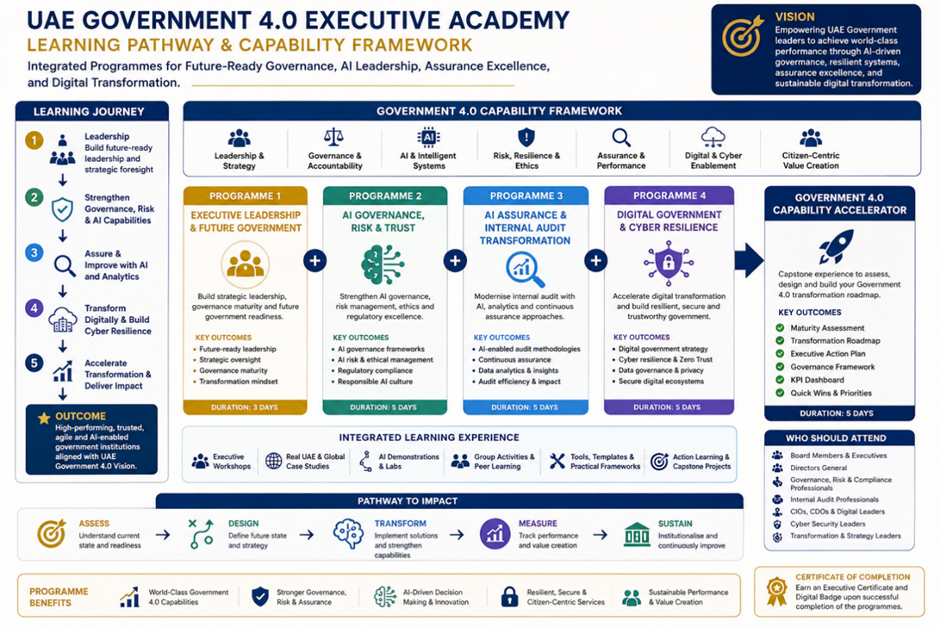
AI Governance, Risk & Trust
Program Audience: Governance and Risk Professionals
Program Outcome: AI Governance & Risk Management Capability
TOPICS
Module 1: Artificial Intelligence Strategy & Governance
Module 2: Enterprise Risk Management (ERM) & Resilience
Module 3: Compliance, Ethics & Regulatory Excellence
Duration: 3 Days
Target Audience:
- Governance
- Risk & Compliance Professionals
- Risk Managers
- GRC Professionals
- Compliance Officers
- Legal Teams
Module 1: Artificial Intelligence Strategy and Governance
Description
Artificial Intelligence (AI) is transforming governments by enabling smarter decision-making, enhancing service delivery, improving operational efficiency, and supporting evidence-based policymaking. This module equips leaders with the knowledge and practical tools required to develop AI strategies, establish robust AI governance frameworks, manage AI-related risks, and ensure the responsible, ethical, and transparent use of AI across government entities. Participants will explore AI fundamentals, governance models, intelligent automation, AI regulations, and emerging technologies while developing practical approaches for implementing AI responsibly within their organizations.
Key Topics
· AI fundamentals and applications
· AI governance frameworks
· Ethical and responsible AI
· AI risk management
· Intelligent automation
Outcomes
By the end of this module, participants will have developed:
- AI Readiness Assessment
- AI Strategy Canvas
- AI Governance Framework
- AI Risk Assessment
- Responsible AI Policy
- AI Use Case Portfolio
- Intelligent Automation Roadmap
- Executive AI Action Plan
Upon completion of this module, participants will be able to:
- Explain AI technologies and their application within government.
- Develop organizational AI strategies aligned with Government 4.0 priorities.
- Design AI governance frameworks that promote accountability and transparency.
- Apply ethical AI principles throughout the AI lifecycle.
- Identify, assess, and mitigate AI-related risks.
- Evaluate opportunities for intelligent automation and AI-enabled services.
- Lead responsible AI adoption while maintaining public trust and regulatory compliance.
Module 2: Enterprise Risk Management (ERM) and Resilience
Description
Effective risk management is fundamental to achieving strategic objectives, maintaining public trust, and ensuring organizational resilience in an increasingly complex and rapidly evolving environment. This module equips leaders with advanced Enterprise Risk Management (ERM) practices aligned with ISO 31000, COSO ERM, and Government 4.0 priorities. Participants will explore strategic, operational, financial, cyber, technology, and emerging risks while strengthening resilience, business continuity, crisis management, and risk-informed decision-making.
Key Topics
· ERM frameworks
· Strategic and operational risk
· Emerging technology risks
· Business continuity
· Organizational resilience
Outcomes
By the end of this module, participants will have developed:
· Enterprise Risk Maturity Assessment
· Enterprise Risk Profile
· Risk Appetite Statement
· Strategic Risk Register
· Business Continuity Improvement Plan
· Organizational Resilience Roadmap
· Executive Risk Dashboard
· Executive Risk Action Plan
Upon completion of this module, participants will be able to:
· Apply internationally recognized ERM frameworks.
· Integrate risk management into strategic planning and decision-making.
· Identify and assess emerging risks.
· Strengthen business continuity and crisis preparedness.
· Build organizational resilience.
· Monitor enterprise risks using executive dashboards.
· Promote a proactive risk culture.
Module 3: Compliance, Ethics, and Regulatory Excellence
Description
Strong compliance and ethical governance are essential for maintaining public trust, ensuring regulatory adherence, and promoting organizational integrity. This module equips leaders with the knowledge and practical tools to establish effective compliance management systems, strengthen ethical leadership, prevent fraud and misconduct, and improve regulatory preparedness. Participants will explore international compliance frameworks, governance structures, anti-fraud programmes, investigations, monitoring, and continuous compliance improvement within the Government 4.0 environment.
Key Topics
· Compliance governance
· Regulatory frameworks
· Ethical leadership
· Anti-fraud controls
· Monitoring and reporting
Outcomes
By the end of this module, participants will have developed:
· Compliance Maturity Assessment
· Compliance Framework Blueprint
· Regulatory Obligations Register
· Ethics and Integrity Improvement Plan
· Fraud Risk Assessment
· Compliance Monitoring Dashboard
· Regulatory Compliance Roadmap
· Executive Compliance Action Plan
Upon completion of this module, participants will be able to:
· Design effective compliance governance frameworks.
· Strengthen ethical leadership and organizational integrity.
· Identify and manage regulatory obligations.
· Develop fraud prevention and detection programs.
· Monitor compliance performance using effective metrics.
· Enhance organizational readiness for regulatory inspections and audits.
· Foster a culture of ethics, accountability, and continuous compliance improvement.